While considering some of humanity’s greatest inventions, many objects come up: the wheel, the printing press, perhaps the light bulb, most certainly vaccines, and how can we ignore the one machine that lets me type this article, the computer, and finally the invention that lets you read this article – the internet. But what about that big steel box on a leviathan of a container ship carrying perhaps Pokémon cards, your favourite snacks, or critical medicines?
It has been 71 years since the modern shipping container was invented. If you speak to freight forwarders from an older generation, they will tell you about a time when the modern container did not exist in the form it does today. Most people outside the supply chain industry take this steel box for granted, but for us within the industry, this simple box is the lifeline and determines so much of our day-to-day business. The container box reshaped the world in less than a century. But how did this one practical invention of the 20th century transform businesses, economies, ports, and cities?
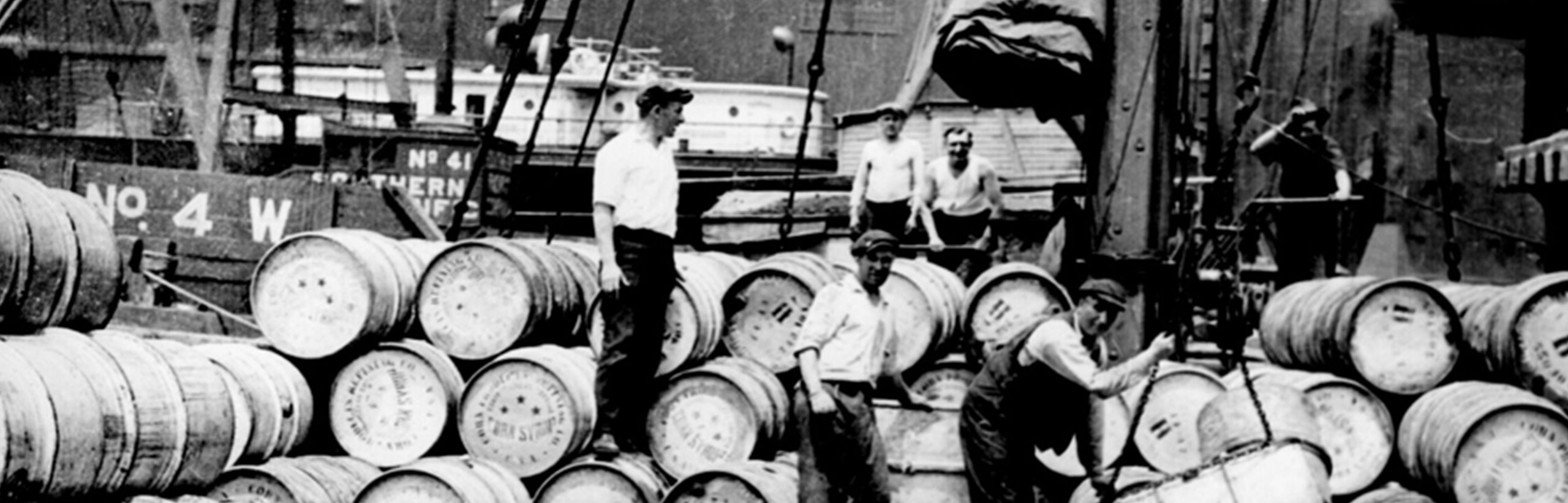
(Dockworkers, Stevedores, and Longshoremen in 1912)
Supply Chain in the BC
Before we get to the invention story, let us remember the BC (Before Container) time period. Breakbulk was the boss then; now, it is relegated only to project cargo or any shipment that does not fit in a container. But during BC, it was the era of Breakbulk shipping. Each piece of cargo was loaded and unloaded piece by piece. While containerization as a phenomenon existed, there was no standardization, so cargo could be in big or small boxes, crates, barrels, and so on. Dock workers manually moved cargo between the port and the ship; cranes and nets were also used to move larger cargo, but the ship-to-shore crane was only developed in 1959.
There was a problem with the manual loading/unloading of cargo. It was excruciatingly slow; ships would be docked at the port for days, and it was also dangerous and labour-intensive. Sometimes, if the cargo was unattended, it became prone to theft and damage. For this reason, shipped goods were traditionally much more expensive, and economies were less global and more localized, meaning that to avoid long-hauls, manufacturers stayed close to the market.
Things would not remain this way.
Enter Malcolm Mclean
Born in 1913 in North Carolina, US, Malcolm McLean owned a trucking company that moved general commercial goods from various ports on the US Atlantic coast to cities and towns. Neither a scientist nor an engineer, this trucking magnate’s invention was triggered by a simple need to make processes more efficient, a necessity that freight forwarders find relatable in this day and age as well.
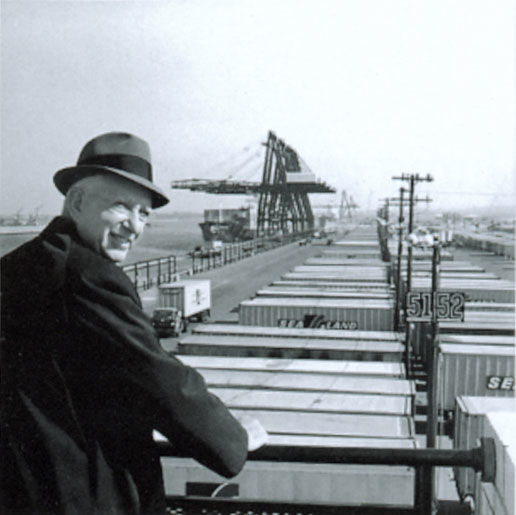
(Malcolm Mclean at Port Newark in 1957)
McLean noticed how long it would take the workers to unload the truck and imagined there might be a better way: a way to lift and drop the entire truck trailer directly onto the ship. That imagination becomes reality, and in 1956, the modern intermodal container comes into existence. The opening lines of Marc Levinson’s book The Box: How the Shipping Container Made the World Smaller and the World Economy Bigger describe the first use of the container:
“On April 26, 1956, a crane lifted fifty-eight aluminum truck bodies aboard an aging tanker ship moored in Newark, New Jersey. Five days later, the Ideal-X sailed into Houston, where fifty-eight trucks waited to take on the metal boxes and haul them to their destinations. Such was the beginning of a revolution.”
This was truly a revolution that brought forth dramatic results. Loading time drastically fell, costs even more so, and theft and damage became close to non-existent. What was thought to be a simple operational enhancement changed how things moved around the globe.
And what happened to McLean? Well, his business grew, and he founded Sea-Land, a container shipping company with a long history that was later acquired by Maersk. In 2023, Maersk eventually retired the brand. Though Sea-Land became a successful enterprise of its own, McLean’s legacy of the container had a far greater impact, especially when it was standardized.
Some Standards are Needed
Not all containers were always the same in the beginning. The shapes were either informed by the cargo they carried or the vessels they were compatible with. But true transformation arrived with the adoption of international standards in the 1960s. The International Organization for Standardization (ISO) established standardized container dimensions, most commonly expressed in two sizes: 20-foot (TEU) and 40-foot (FEU) containers. Standardization unlocked a new global dimension of interoperability.
By 1972, ISO had mandated certain regulations, including containers to be fitted with CSC safety-approved plates. These plates contain all critical information about the container, including age, dimensions, registration number, stacking capability, and more. Now containers could seamlessly move between ships, trucks, and trains; between cities, countries, and continents.
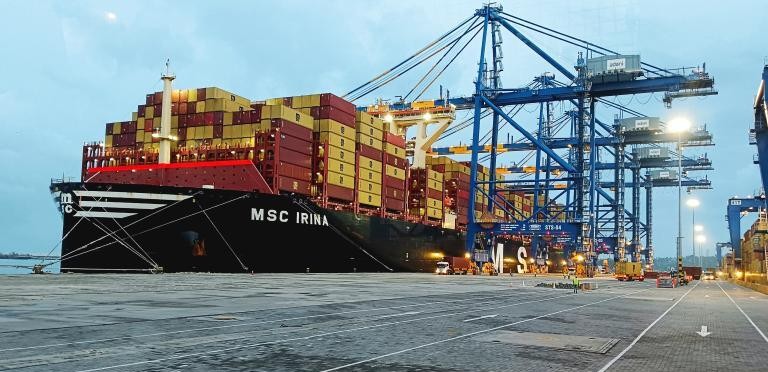
(MSC Irina, one of the largest container ships, docked at a modernized port)
Changing Infrastructure
This simple box has been responsible for significant infrastructure and operational changes in ports around the world. Ports were now required to have giant gantry cranes, acres and acres of land to create container yards, intermodal connections with trucking and rail, and to transform into deep-sea ports where ships, essentially floating warehouses, could park.
Not all ports could sustain these demands. Many traditional ports in densely populated areas diverted traffic to larger facilities. Meanwhile, growing nations invested heavily in container infrastructure (Singapore and Shanghai) and transformed themselves into a powerhouse of global trade.
Apart from a physical transformation of ports and cityscapes, there was a booming economic transformation that moved hand-in-hand. Remember the buzzword of the 80s and 90s, Globalization. Through Globalization, that matcha from the Kyoto Prefecture was now readily available in the suburbs of Miami, Florida. One can thank the container for such a paradox. Nevertheless, manufacturing could now move to parts of the world away from the market, closer to the raw materials and labour, thus giving rise to export-driven economies. Now, behind every product, there exists a complex global supply chain. While people believe that trade agreements, open borders, and tariff reductions have created this global economy, the fact of the matter is that this steel box has done more for the world than politicians, trade organizations, and business gurus. So, the next time you see a stack of containers at a port, or on a truck going past you on the highway, or a chain of them on a train as you wait on the platform to board, you will be reminded of how a steel box caused a revolution.

.svg)
.svg)


