With nearly two decades at Airmax Cargo behind her, Diána Merczel, the recently appointed Chief Multimodal Operations and Logistics Officer, embodies the company’s values in her work, of being a focused, people-driven logistics provider in a complex global supply chain. As she takes on the new role, she brings deep knowledge and a commitment to transparency while honing a leadership style rooted in collaboration. Diána now balances operational and strategic decision-making excellence with customer satisfaction while cultivating a culture of trust, equity, and open communication.
In this interview, we speak to her about Airmax’s growing capabilities, the need to develop multimodal solutions as a form of resilience in the changing logistics landscape, and the challenges and opportunities of her new role. Furthermore, she reflects on the various solutions Airmax offers and the company's work culture, which has created a mindset that combines operational rigor with human touch.
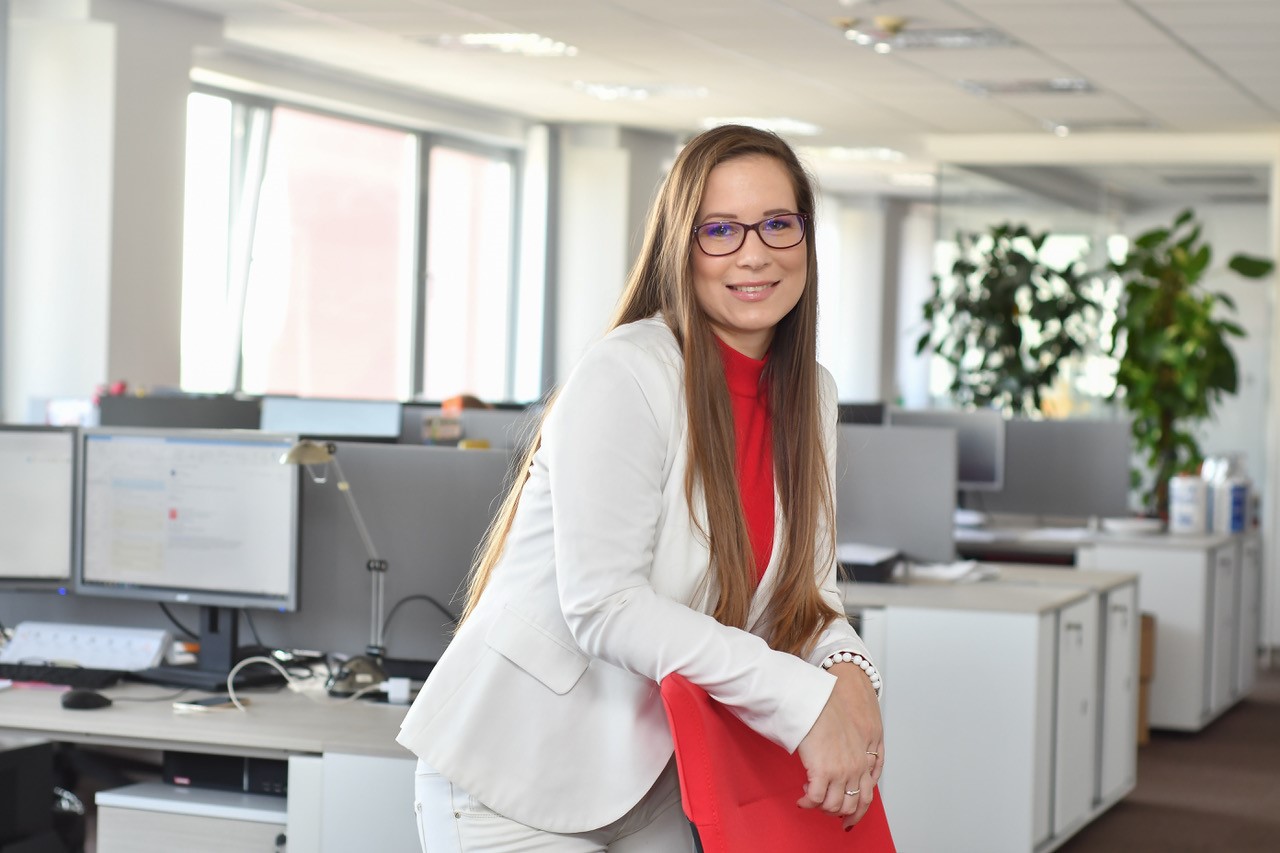
(Diána Merczel. Picture Credit: Airmax Cargo)
NSRN: Congratulations on your new position! As the Chief Multimodal Operations and Logistics Officer of Airmax, how have your responsibilities transformed? What are some ways in which you think you can bring your expertise to the position, and what are your overall expectations from the new position?
Diána: It is an incredible honor to have this promotion. This is my 17th year at the company, and it’s been a massive part of my life. I really enjoy working here. I have learnt so much and had so many experiences! I have lovely colleagues, too, who have seen me through both the ups and downs, and it makes me feel lucky to have found such a place. And now with this promotion, I feel like I have arrived at the top of Mount Olympus.
Initially, I was a bit nervous about filling such large shoes and taking on such a demanding role. But then I began approaching my tasks and my challenges from a different angle. I asked myself what was missing and what I could learn, and in that way, I think I have found my footing. Moreover, there is good equity in our company, especially within the senior management level, where we have different backgrounds, but yet we work for the same: a competitive and efficient company culture people can trust.
In my previous position as Head of the Sea Freight and Road Department at Airmax Cargo, I led around 40 people; now that number has jumped to over 100. Apart from the personnel, my focus has also shifted. Now, in addition to managing the operational teams and customer satisfaction, I must consider how our supportive departments work with the air, ocean, and rail freight departments, with a focus on last-mile deliveries, warehousing or customs clearance. This sort of management requires a different mindset, coordination between the company's clients and the people you are responsible for. So, every decision I make now must keep both sides in mind, which is not necessarily the easiest task.
I think my team understands they can rely on my support with the tasks and challenges they face, which adds a lot of positivity to the team dynamics. I only started this position in January, so right now a lot of my time goes into meetings with the team, exploring current workflows and co ’working between the departments. I want to create a culture of transparency that allows both my team and clients to understand the thought processes behind our decisions.
NSRN: There’s a picture on Airmax’s website from 1996, the year of your founding, along with a story of how the company started. It’s such a lovely picture because it captures the essence of logistics: communication, collaboration, and information sharing. From a small office in 1996 to a team of over 140 dedicated and professional forwarders, what do you think has largely been the winning formula for Airmax? Moreover, as you have been with Airmax for over a decade now, in your opinion, how does the company reflect its core values and principles in its day-to-day operations?
Diána: Yes, I agree it is a lovely picture. You might find it interesting that of the three people in the picture, two are still with the company, and the third is now our client. Honestly, I feel like it says a lot about our company and really reflects our motto, “We are more together.”
While our company is divided into various operational fields, our client portfolio is large, and we have stayed competitive thanks to our strong ability to adapt and the quality of our work. Our CEO always says, "We want to be the best, not the biggest”. This has always been our idea from the beginning, which is why quality has been our top priority and continues to be one of our three pillars, as our new Deputy CEO introduced to us.
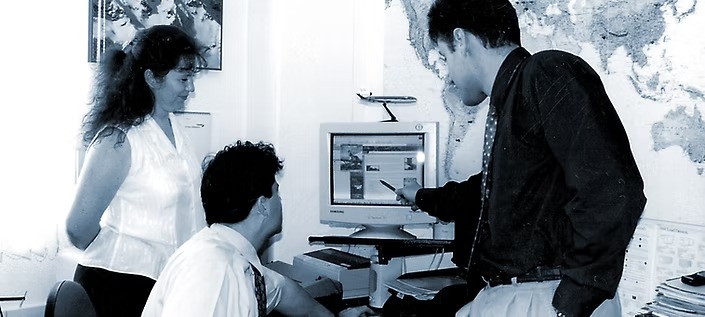
(Airmax Cargo in the early days, 1996. Picture Credit: Airmax Cargo)
When someone new joins us, we introduce them to these aspects of our company, along with the tasks, a sort of “airmaxization”, like an initiation process. Because of how our people work, our proactivity, clarity, and responsibility are now a natural expectation among our clients that we uphold these values. This also helps us maintain good reports and solid scores. While productivity and proactivity are now expected across the business, we also offer flexibility to align with our customers' needs. From the first meeting to the issuance of the final debit note, we do our very best to keep them pleased.
NSRN: The Ukraine-Russia war has largely disrupted rail freight via Russia. Last time we spoke, close to the beginning of the war, you had already foreseen that these disruptions would not resolve so easily. What solutions have you generally found to make Airmax more resilient, especially in a world where tariffs, sanctions, and wars seem to be never-ending?
Diána: So much has happened, and it’s unfortunate that the war still goes on. That’s why joining a network like NSRN really helped us at the time, when we were searching for a solution for our rail import service. This was a good opportunity for us, as we were able to find a reliable partner in China: Ocean Bright Logistics.
Back then, there were many supply chain issues, especially with the reliability of ocean transit times. As the automotive industry was booming, many sought to access the Silk Road by moving freight by rail. We also considered this opportunity and reached out Ocean Bright Logistics. We have started our rail consolidation, and our FCL and LCL solutions are now in service. With our partner, we could evaluate every risk that would emerge when we undertake such a consolidation. We checked all EU sanctions and regulations along the route and began our new service, which continues to function smoothly. We have one departure a week from Xi’an for our LCL. It moves through Kazakhstan, Russia, and Belarus, and the container arrives in Poland. From there, we transport the cargo by road to our warehouse in Budapest to expedite transit. We rarely face any disruptions with departures. If there are any tensions at the Belarus-Poland border, we switch our solution and move the cargo by road. We have already tried Trucking all the way with Ocean Bright, starting from China, and it has worked very well, with minimal difference in transit times. I would say that was a brave solution on our part, given the tensions from border closures and inspections in Russia. Transit through Russia often involves inspections. Still, we ensure the cargo is thoroughly handled on our end before loading, so we can prevent any issues as it moves through Russia.

(Picture Credit: Airmax Cargo)
Our LCL Manager and her expertise in managing these multimodal solutions has been invaluable so the performance of this consolidation last year was excellent, well above our expectations and targets. Since Airmax works with different modalities, we can offer a range of solutions to our customers, and thus be flexible to their demands. For example, if someone approaches us with import cargo from China, we can offer a wide range of solutions, from time-critical and hand-carry to regular ocean transport; it’s just a question of time, money, and predictability. We are prepared for changes, and we can adapt quickly.
In addition, we have weekly departures from China to the Adriatic ports, sailing around the Cape of Good Hope and generally avoiding the Suez. I would say, the transit time is rather reliable (Since the interview was done before the Middle East conflict, the shifting circumstances have impacted transit times).
NSRN: One of Airmax’s strengths is developing specialized solutions and unique products to meet a variety of customer demands. With your expertise in multimodal logistics, what are some of the nuances involved that allow you to offer reliable and efficient service? And what do you think multimodal logistics offers as an advantage over single-mode logistics?
Diána: I cannot really imagine being anything other than multimodal. Moreover, everything belongs to the company, which allows us to have a direct impact on the procedure. Our warehouse near the airport assures our customers that their cargo is in the best hands. We also have a fantastic relationship with the customs authorities at Budapest Airport. Since we are based in the region and have our in-house customs department, we have many avenues to reach our solutions.
Having our own warehouse also removes questions of priority. It is your people you can reach out to at any time and sit with them to discuss the best possible solutions; that is tough to do when a third party does the warehousing. Similarly, we have an in-house road freight department that helps us manage our first and last miles.
It is also a very transparent system, since we have our own rules and SOPs, which are being updated right now, and we have our own quality management systems. At Airmax, CTO and COOs work closely together in creating an efficient ecosystem, that supports our team. By undertaking such operational analyses, we obtain the exact information needed to make tweaks if needed or compare modalities and equalize them when necessary, to arrive at the most optimal plan. These processes have been in place since Airmax Cargo’s expansion, and now that we are close to two hundred people, our strategies and methods must be aligned. Since we want to offer the best to our customers, we ensure we have control and transparency over every aspect of the supply chain we manage. We are on the way, we are always learning.
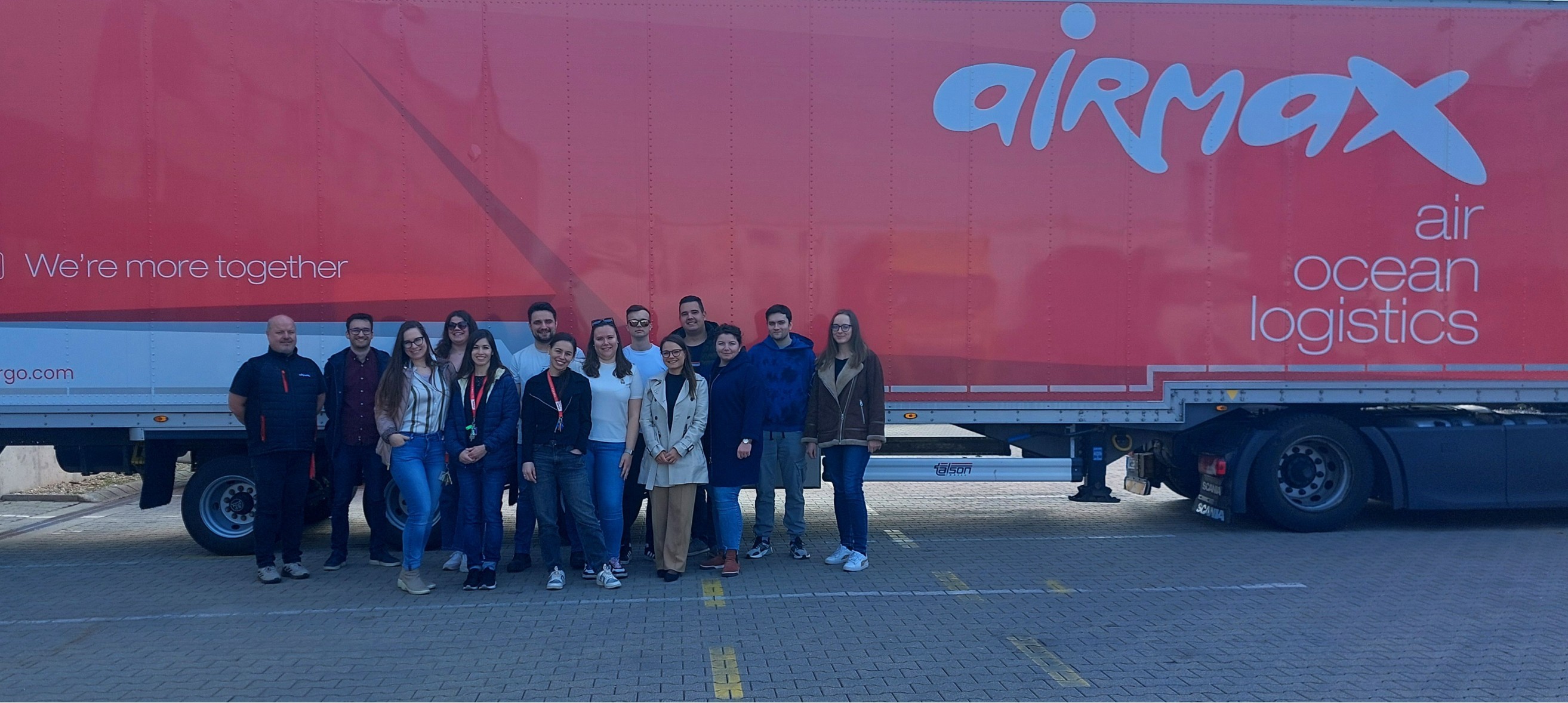
(Diána Merczel with her team. Picture Credit: Airmax Cargo)
A customer may book road, air, or ocean, the quality of our service must remain the same in any modality. Since we are multimodal, we can be very flexible. From China, we mostly move higher-value, time-sensitive products by rail—cargo from seasonal production, or automotive-related.
There was this one time when we were transporting Pikachu hats. It’s hilarious because the custom codes for the military hats start with the same prefix as the Pikachu hats. We were worried that the Russian customs might flag that. But we have been moving pretty much anything or everything, especially via ocean freight, where we move small electrical parts, or cinema popcorn boxes, or special printers, some promotional merchandise with Shrek, and once Star Wars, probably even the pen I’m holding!
NSRN: What are some prospective goals for this year? Are there any interesting developments, new products, or projects that are on the horizon?
Diána: This year, we are launching a very special product in the pharmaceutical supply chain. We are now able to do pharmaceutical consolidation. We have joined a network specific to the pharmaceutical industry, through which we have been able to organize groupages and even small parcels. This is a specialized area of business due to its many requirements. The quality of our services must maintain high standards, and we must also adhere to the strict rules of the pharmaceutical industry, such as GDP requirements. Through our parcel consolidation, we can offer very competitive solutions to our pharmaceutical customers, especially those who do not have enough cargo to load a truck or van. If a cargo is not time-sensitive, we have fixed schedules and agreeable delivery timelines. Because of the range of our solutions, we can move a small box of pharmaceuticals from Hungary to another location in Europe and vice versa.
Our warehouse and road freight departments work together to develop these specific capabilities to serve this niche industry, which involves investments from our company. We purchased Bi-temp trucks that are specialized for temperature-sensitive cargo. We recalibrated our systems and processes to enable these deliveries. We hired and trained people specifically, and we also hold all our certifications, including GDP and CEIV. The CEIV certification is much stricter and primarily applies to air freight, but we maintain strict lane risk assessment for every modality when shipping pharma goods.

(Diána Merczel. Picture Credit: Airmax Cargo)
On a personal level, I want to sharpen the skills needed to be a good leader. I want to create a secure and sound work environment for my colleagues so we can continue working to solve our customers' problems. I am surrounded by wonderful people and have many mentors within the company. Even on very stressful days or moments when priorities are turned upside down, I know there are experts around me that I can rely on. Security, for myself and those I work with, has always been a top priority. In the logistics industry, which is often affected by market dynamics and frequent change, building resilience is one way to achieve that sense of security. When you have the right people around you, safety comes naturally, and that means a lot to me.

.svg)
.svg)


